From Coding Assistant to Engineering Partner: AI Agents Across the Development Lifecycle
Reducing Engineering Friction, Accelerating Innovation
✍️ About this article
The idea, perspective, and original draft are my own. I used AI assistance to review and polish the wording, check that the content is original and properly referenced, and create the visuals. Every claim and conclusion here reflects my own view.
As software developers, we spend a large share of our time on work that isn't writing code. Requirements, system design, implementation, testing, verification, code review, deployment, and monitoring each need real attention, usually from several people on the team.
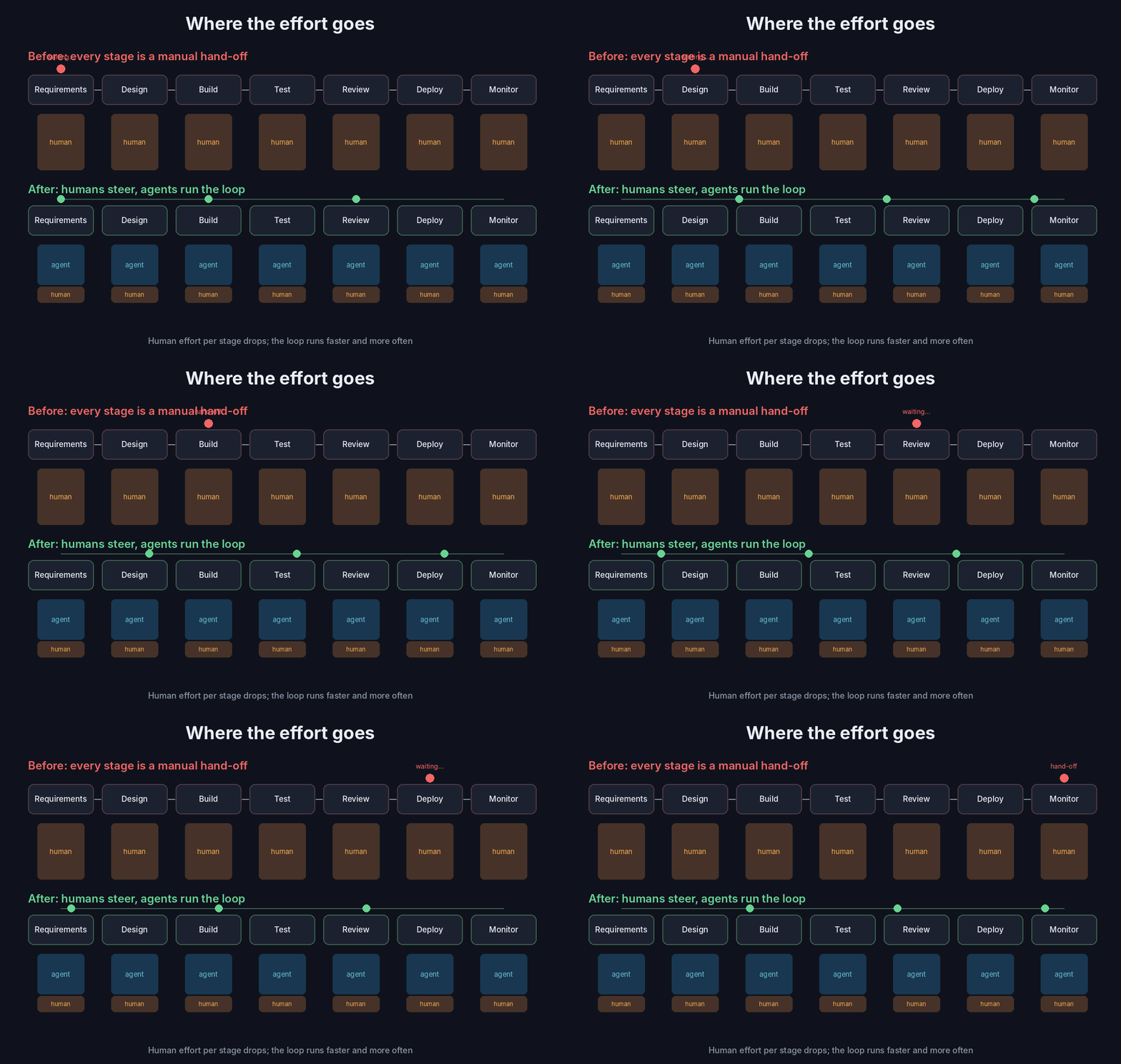
In a traditional setup, most of us contribute to several stages of the same process. That collaboration is valuable, but it also creates bottlenecks. A lot of time goes into translating requirements, finding edge cases, reviewing implementations, writing tests, and checking whether the solution actually delivers the intended outcome. Each hand-off between stages is a place where work waits.
(AI Generated: Claude)
From coding assistant to engineering partner
AI agent engineering gives us a chance to change this process at its foundation.
Instead of using AI only to write code, we can involve agents across the whole engineering lifecycle. An agent can help interpret requirements, explore the existing system, propose designs, find edge cases and blind spots, generate tests, verify implementations, analyze failures, and suggest improvements.
Just as important, agents add an extra layer of reasoning alongside the team's own experience. They can spot gaps we overlook, question our assumptions, surface problems early, and suggest approaches we might not have considered.
Not replacement — redistribution
None of this means replacing the engineers in the process. It means reducing the manual effort each person has to spend, while increasing how much engineering work the team as a whole can get done.
The shift looks like this:
| Before | With AI agents | |
|---|---|---|
| Who does the work at each stage | People, at every step | Agents execute; people steer |
| Human role | Doing, reviewing, handing off | Direction, judgment, context |
| Feedback | Slow, often only after release | Continuous, at every stage |
| Bottleneck | Hand-offs and waiting | Quality of goals and checks |
Loop Engineering: AI in the whole loop
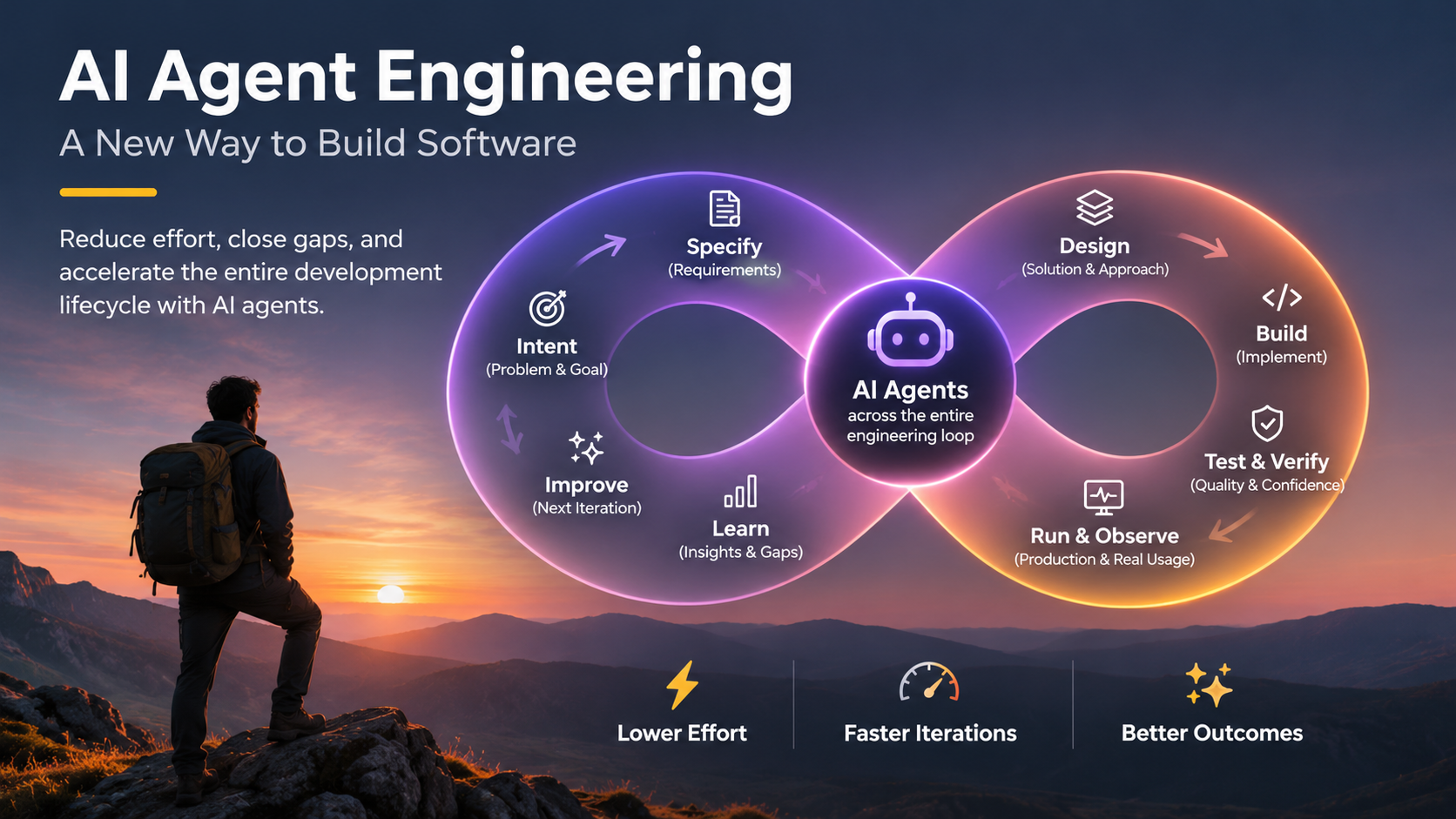
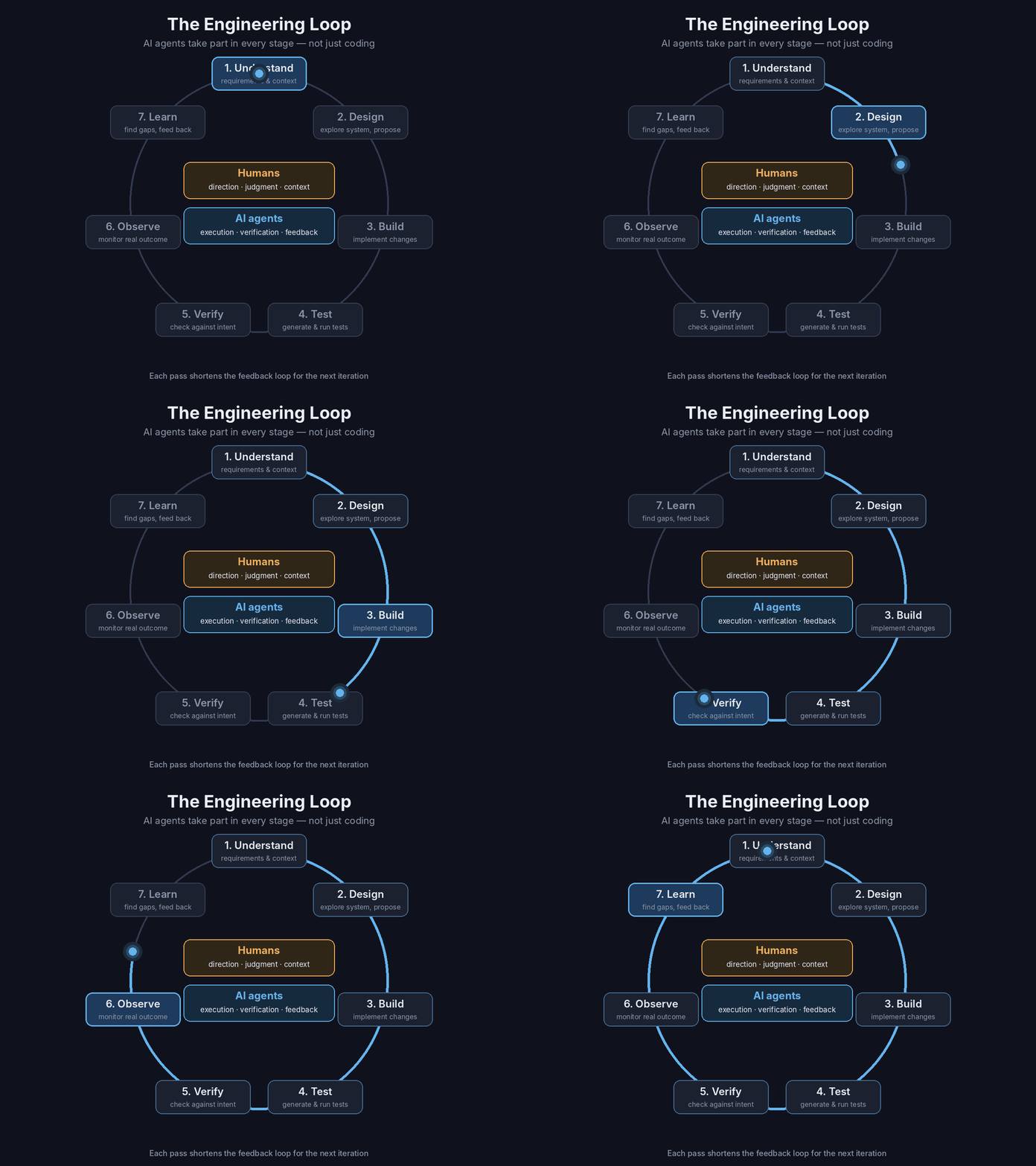
This is where the idea of Loop Engineering becomes interesting. The term has recently gained traction among developers working with coding agents [1][2]. Instead of AI helping only at the coding stage, it takes part in the entire loop: understanding the problem, designing the solution, building, testing, verifying, observing the outcome, finding gaps, and feeding what it learned into the next iteration.
(AI Generated: Claude)
The humans in the middle of the loop matter. Agents are good at execution and at checking work against clear criteria, but someone still has to define what "done" means, decide which trade-offs are acceptable, and catch the cases where the agent is confidently wrong. A faster loop with poor goals or weak verification just produces mistakes faster.
The real opportunity
The goal isn't simply to make developers type code faster. The bigger opportunity is to remove friction across the whole engineering lifecycle, shorten the feedback loop, and let teams iterate more often, with the potential for better outcomes each time around.
References
- John K. Waters, "Loop Engineering Emerges as Developers Put AI Coding Agents on Repeat," ADTmag, July 1, 2026. https://adtmag.com/articles/2026/07/01/loop-engineering-emerges-as-developers-put-ai-coding-agents-on-repeat.aspx
- Arkadiy Kondrashov, "What Is Loop Engineering?" Kilo. https://kilo.ai/articles/what-is-loop-engineering
About the author
Software Engineer with over a decade of experience in building monolithic to microservices with PHP, Java (Spring), JavaScript (Node, Vue), Erlang/Elixir (Phoenix), Search engineering (Solr, Elasticsearch), Cloud (AWS).
Comments
Join the discussionYour table moves the bottleneck to the quality of goals and checks, and that matches where I got stuck. I wrote about capturing a hundred agent failures a week and fixing three, and the slow part was curation, sorting them into checks the next loop could use. Who on your team turns a gap the agent finds into a new check?
Hey Kartik, that's a very good point, and I completely agree with you. This is something I'm also struggling with. I'm curious to hear your thoughts on how we could address this and turn those gaps into actionable checks.
Treating agents as partners instead of basic auto-complete shifts the focus to context boundaries and verification loops. That distinction matters more than raw generation speed.
The transition from inline code completion to autonomous lifecycle agents shifts the bottleneck directly to context management and deterministic verification. An agent that cannot verify its test suite before opening a PR creates more triage debt than it saves.
The shift from using AI as a coding assistant to treating it as an engineering partner is a really important change. Writing code is only one part of software development, and having AI contribute to planning, testing, debugging, and reviewing makes its role much more meaningful.
What I find particularly interesting is how this could change the way developers spend their time. Less effort on repetitive tasks could mean more focus on problem-solving, design decisions, and overall code quality. Still, human judgment and accountability need to remain part of the process. The real value comes from combining AI's speed with engineering experience.